 72nd to 75th 4000 m summits
16 August 2025 · Mont Blanc
The full Brouillard ridge: gratitude & emotion
The track
Distance and elevation gain from the Strava tracks; profile drawn from the GPS. Hover over the map or the profile to locate a point along the track.
The figures
From 16 July (start 05:27) to 18 July 2025 (finish 10:01) · 2 nights — Bivouac without a tent, Refuge du Goûter
Summits & route
The summits
Day by day
- D1Val Veny > Col du Brouillard > Punta Baretti > bivouac
- D2Mont Brouillard > Col Émile Rey > Picco Luigi Amedeo > Mont Blanc de Courmayeur > Mont Blanc > Goûter hut
- D3Descent to Les Houches
Climbing partners
Click a name to see their map.
Topos & references


The story
So many emotions at the end of these 3 days. A unique adventure that has marked all four of us forever. An adventure in which friendship and solidarity allowed us to face the vertigo of death.
The Integral Brouillard: a legendary route that starts from the Italian Val Veny and climbs the Brouillard ridge from its foot to the summit of Mont Blanc. The route follows an extremely aesthetic ridge, but also an extremely rotten and loose one, on shattered rock almost all the way. The route is therefore legendary for the commitment it demands and the absolute severity of the place, and the climbing — without ever being very technical — is most of the time delicate and exposed.
Located in the heart of the Italian side of Mont Blanc, it offers, along with its neighbours the Innominata and the Peuterey, THE grandiose ridge climb par excellence, calling to the ascent anyone who has ever set eyes on their outlines.
As my quest for the 4000ers nears its end, the Brouillard and the Peuterey are the last big sticking points. Finding acceptable conditions has become a headache, and when conditions do come together, several rope teams jump at the chance, adding a factor that is rarely welcome — a greater danger of rockfall and more pressure on bivouac spots. In mid-July, Marc-Henri, Anthony and I had made an attempt on the Peuterey, an attempt that pushed us to our limits and exposed us to a level of commitment and danger beyond what we could accept. Turning back a few metres from the summit had been very hard on morale, but was unavoidable given the circumstances.
A month later, conditions look promising again. The ridge is dry and the weather very stable; the only big problem is the very high freezing level and the rockfall that goes with it. For a week, all my thoughts are directed towards the Brouillard ridge: I study every point, call acquaintances, think through every parameter while far from the mountains. A team is put together, preparations get under way, and the decision is taken to set off on the integral at dawn on Saturday.
I'd also like to take this opportunity to thank Adrien and William for their excellent and meticulous trip reports, both of which were a great help in preparing the climb. Thank you, and congratulations on your fine achievements: between the single push and the successful ascent with a shoulder in a sorry state, we can only salute your daring.
I'd also like to thank Nicolas B. for his invaluable advice, his expert view of the strategies we were considering, and his kind attention towards me.
After waking up in the middle of the night and driving to Italy, we're at the start by 5:30 to begin this famous integral Brouillard. Here we are. All the planets finally seem aligned: favourable conditions and top-notch climbing partners. We know that what awaits us is immense, but the group's energy and dynamic couldn't be better.
The first day consists of climbing the famous “infamous vertical kilometre” of grassy slopes, followed by that long rocky ridge of often very dubious quality, with its multitude of gendarmes, towers, ledges, downclimbs and so on. Quite quickly, we overtake a party of 3 Italians who set off at 1 a.m. We can see 2 other rope teams in the distance and close in on them, then keep them in sight without overtaking them — we're moving efficiently but stopping at every opportunity to replenish our water. So we know there are at least 4 people ahead of us (including one guided rope team) and 3 people behind. That's a lot; we'll have to be extremely vigilant and attentive to one another. After about ten hours of climbing, we reach a bivouac spot that seems suitable, just after crossing Punta Baretti, where M. and V., a French couple, are already settled. This first day saw us put in a big effort on terrain that already involved plenty of climbing, and we're very happy to be able to lie down and rest our weary bodies. The altitude is hitting hard, and I'm counting on these few hours of rest to recharge my batteries, given what awaits us the next day.
In the evening, as the sun sets, we see the party of 3 Italians we had overtaken early in the morning appear on the summit of Punta Baretti behind us. Instead of abseiling along the ridge, they head down the flank on the Brouillard side. Despite our warnings and shouts, they seem to be following bits of cord, probably left by other people who had gone astray… It's late, they're in a perilous situation, clearly off route, and we're very worried about them. We call the rescue services to inform them of the situation and trigger a pre-alert, so that they're ready to intervene if needed.
Fortunately that won't be necessary, and an hour later the party gets out of trouble and joins us. For a whole host of reasons, it troubles us: the Italians took 20 hours to climb the section of this first day (double our time), they arrive utterly exhausted at a bivouac already fairly cramped, with 6 people who had long been ready to sleep, and they could seriously endanger us the next day if they were to set off before us into the Émile Rey pitches. I take the time to talk with them and make them welcome: they're kind and grateful, but I can sense something's not right. A bad intuition, like the feeling that they're not in the right place. Packs far too heavy, route-finding errors, a blown schedule, poor communication between them — we had heard them shouting several times during the day, which is never a sign of serenity in the high mountains. I make a bit of room for them, get out of my sleeping bag to hand them a block of ice, and try to be comforting. Above all I advise them to rest well, and suggest staggered departures for the next day: we'll set an alarm for 4 a.m., M. and V.'s rope team for 4:30, and they could follow after some much-needed rest.
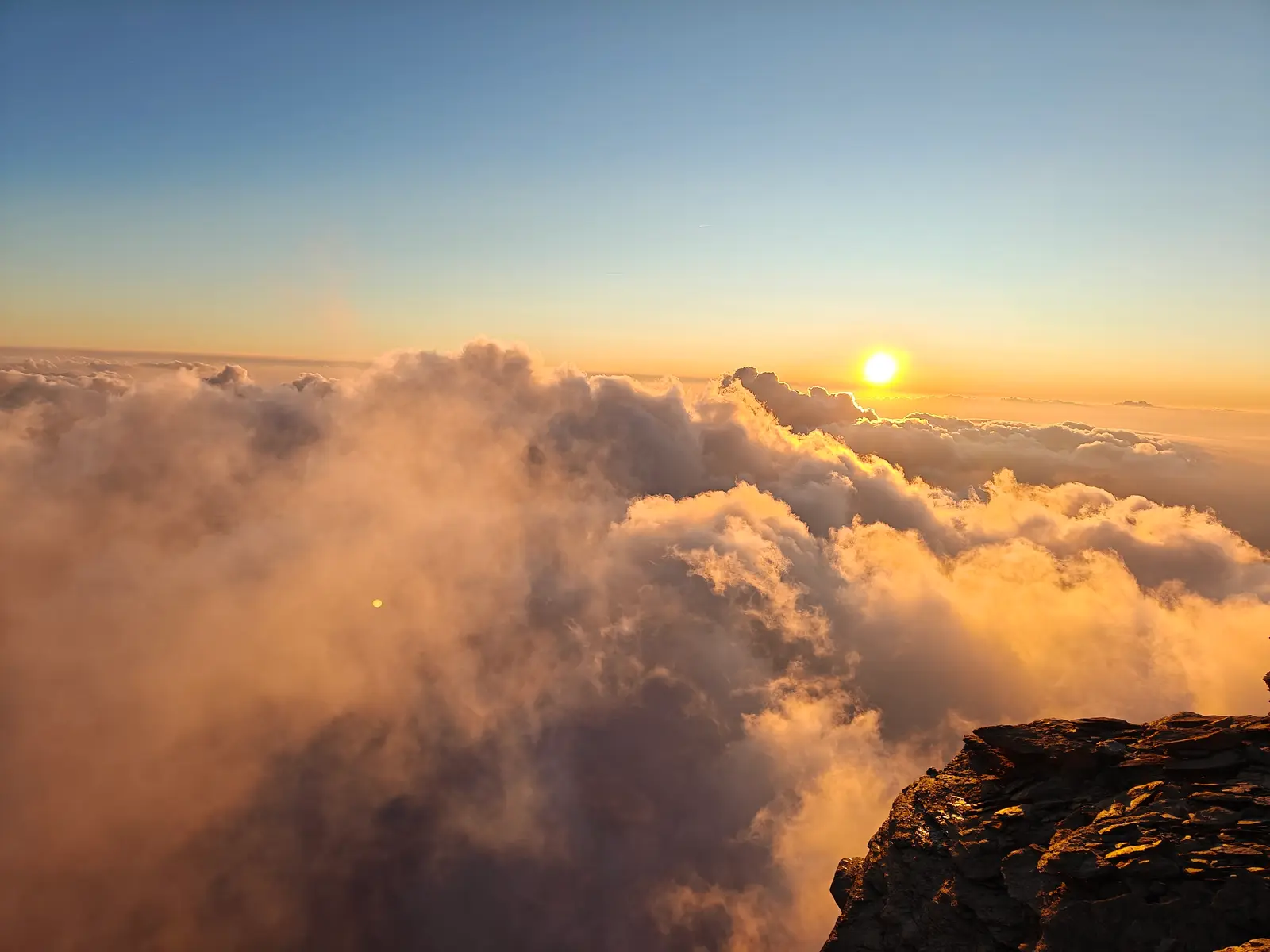
After a magical night at 4000 m, under a sky sometimes starry, sometimes a veritable ballet of dancing clouds, the alarm goes off at 4 a.m. Packing up and breakfast are done at top speed in the biting cold, and we quickly set off along the rest of the route. Very soon, I suggest getting the ropes out. The day before, we had climbed for hours and hours without a rope, which seemed reasonable and acceptable given the group's level, but now, in total darkness on these ridges alternating between climbing and downclimbing, my intuition tells me that moving unroped would be foolish. Étienne and I form one rope team, Anthony and Alexandre another. Progress is slower and less efficient, but that's the price of safety.
We reach Mont Brouillard, the second 4000er on the ridge. We descend its North ridge and find ahead of us the guided rope team, starting up the famous pitches of the Col Émile Rey. This section is the crux of the ridge: more technical climbing, execrable rock, and a wall above that is liable to unload all its shrapnel once the sun is up. You have to climb with infinite care so as not to dislodge rocks onto any rope teams below.
Unfortunately for us, the situation soon turns catastrophic, and we are hit by the most terrifying rockfall imaginable in the middle of the climb. From the second pitch onwards, we're right in the middle of the wall and missiles are raining down around us. The moment is truly horrible: you have to press yourself against the rock, pray and wait for it to pass. The tension is enormous; I see rocks the size of a tennis ball, and sometimes of a football, whizzing a few centimetres from the head of Étienne, huddled against the rock. I check on Anthony and Alexandre's rope team below, and on M. and V., with whom we had coordinated our departures. We try to protect ourselves as best we can, but it's hellish. My turn to launch into a corner that funnels plenty of the falling rock: I grit my teeth, don't look up and go for it. A rock slams into my foot at full speed — bearable pain; another hits my helmet square on, making me stagger, the shock so violent it jars my jaws; I scream as if to expel this unbearable tension. I get to shelter, and then a terrible crash rings out behind me: I turn my head and see a body sliding at dizzying speed down the wall of rock and ice, directly below Mont Brouillard. It's the first time I've seen anyone fall in the mountains; I'm stunned, completely in shock. It all happened so fast; I try to understand, to make room for analysis rather than emotion.
I immediately call the rescue services, half in tears. It's one of the Italians from the night before. They set off early, didn't rope up and were once again in a bad couloir instead of staying on the ridge. The one leading fell, and within seconds was sliding, dragging lots of rocks along his path. At that moment, I tell myself he's very seriously injured, as if unable to accept the idea of a man dying before my eyes. I beg the rescuers to hurry, hang up, and go to join Étienne at the belay. We're both shaken, really shaken. Within a few minutes we've heard death whistle a few centimetres from our ears, and seen it a few metres below us.
The emotion is immense, between the rockfall that bombarded us and seeing a man fall. From that moment on, we make every effort to move extremely cautiously, protecting every move, testing every handhold, every foothold. For long hours we continue our ascent to the background sound of helicopters and rescue teams searching for the climber. After a while, the body of the deceased is recovered down on the glacier, and the two other Italians are evacuated from the ridge. The guided rope team that was ahead of us and sent all those stones down on us is now far ahead, and the other 3 rope teams (the four of us + the French couple) choose to move together so as not to endanger one another. It takes an enormous amount of concentration and time, but we manage to progress while guaranteeing the safety of all 6 of us.
On reaching Picco Luigi Amedeo, we finally get a view of Mont Blanc, where the ridge culminates. According to the topo, it would take another four to six hours to get there. The emotion runs high in each of us, but we know we can't give it too much room yet, not before we're out of the difficulties.
The ridge is indeed endless: always new steps, new difficulties... Being four lets us share the mental load and occasionally release all that pressure by taking turns leading. We cross Mont Blanc de Courmayeur — the traditional hug — then continue up a few nasty ice slopes to reach the Col Major. We know it means the end of the difficulties.
We reach the summit of Mont Blanc after 12 hours on the go, and emotion overflows the concentration that had filled all our thoughts until then. A call to the Goûter hut to let them know we're coming out of the Italian side of Mont Blanc. An hour and a half later, we put down packs, crampons and harnesses, and exchange looks and a hug that express our gratitude to one another and our relief.
The next morning, an early start and back down to the lowlands. Once past the famous Goûter couloir — insignificant after what we had lived through over the last two days — it's time to rediscover a quiet, gentle, serene mountain. It's also time to talk together, and then to reflect on everything we've been through.
1) The rope team. We agree that we did our best. That the human factor was impeccable throughout, with mutual support, listening, communication and attentiveness despite the hard moments. That our 2 rope teams worked superbly, and that moving as a four was reliable and safe. Thank you, Étienne, for your steadiness, calm and solidity; Anthony, for your assurance and competence; Alexandre, for your endurance and energy. Thank you for this friendship that never wavered on terrain where everything was crumbling.
2) The conditions. Overall, conditions were very favourable, but the presence of the rope team ahead of us in the Émile Rey pitches put us in a situation of danger that we cannot calmly accept. We ourselves moved slowly and carefully, without sending stones onto the rope teams below, communicating every time among all 6 of us to guarantee everyone's safety.
3) Facing death. This is the great trauma of this climb. Seeing someone fall, the violence of the fall, replaying the scene over and over... All of this will take time to process, and for each of us to redefine our relationship with the mountains. On Monday evening he was no longer just “the Italian”: the press told us his name was Davide Migliorino, that he was a teacher and that he was 36. I saw his face in numerous articles and was overwhelmed by emotion. I can still see his smile when I wished him goodnight the evening before. He was happy to be there. Exhausted but happy, living his passion to the full. My deepest condolences to his family.
On a personal level, the contrast is unsettling. On the one hand, immense satisfaction and overflowing gratitude for what we lived through: 3 days of solidarity and camaraderie in the massif, a successful ascent on the austere Italian side of Mont Blanc, and the dream of the Integral Brouillard come true. On the other, the vertigo of death. The implacable realisation that the mountains are dangerous and can, in a split second, devastate lives.
It is up to each of us to find the right balance between daring and exposure, and to live in harmony both this love for the mountains and the love of those who matter to us.